Key Takeaways
- Ihram is a state of consecration entered with intention and Talbiyah – not just the white cloth.
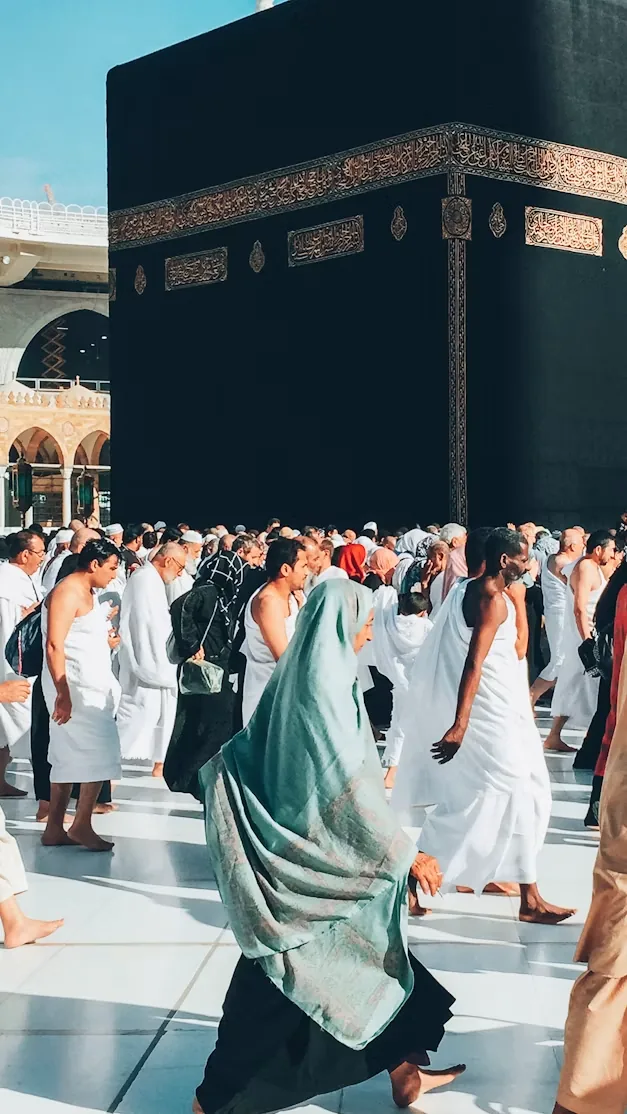
- Men wear two unstitched white sheets; women wear normal modest clothing.
- Perfume, cutting hair or nails and marital relations are forbidden in Ihram.
- Mistakes may require a penalty (dam or fidyah) – consult a scholar.
In this article
Many people think of Ihram as the two white sheets worn by men. In fact, Ihram is a sacred state you enter by making the intention for Hajj or Umrah and reciting the Talbiyah. The clothing is only part of it. Understanding the rules helps you stay focused and avoid mistakes.
Ihram Dress Code
For men
- Two white, unstitched sheets: the izar (waist wrap) and the rida (shoulder wrap).
- Head must remain uncovered.
- Footwear must leave the ankle bones and the top of the foot exposed – simple sandals or slippers.
- A belt, money pouch, watch, glasses and ring are allowed.
For women
- Normal loose, modest clothing that covers the body, in any colour (no special Ihram dress).
- The face should not be covered with a niqab and hands should not be covered with gloves. Many scholars allow lowering a cloth over the face in front of non-Mahram men.
- Socks and normal shoes are allowed.
The Miqat: Where Ihram Begins
The Prophet ﷺ fixed five Miqat points around Makkah. Pilgrims must not cross them without Ihram if they intend Hajj or Umrah.
| Miqat | For pilgrims coming from |
|---|---|
| Dhul Hulayfah (Abyar Ali) | Madinah – used when travelling to Makkah from Madinah |
| Al-Juhfah (Rabigh) | Syria, Egypt, North Africa |
| Qarn al-Manazil (As-Sayl al-Kabir) | Najd, Gulf region and many flights from the east |
| Yalamlam | Yemen and the Indian subcontinent (by sea and many flight paths) |
| Dhat ‘Irq | Iraq |
Change into Ihram before boarding (aircraft toilets are tiny) and make the intention when the crew announces the Miqat – usually 30–60 minutes before landing in Jeddah.
10 Things Forbidden in Ihram
Cutting or removing hair
From the head or any part of the body.
Cutting nails
Using perfume
On the body or clothes, including scented soap, shampoo, wipes and creams.
Marital relations
And anything leading to them. This is the most serious violation.
Marriage contracts
Getting married or proposing.
Hunting land animals
Men: stitched, fitted clothing
Shirts, trousers, underwear, socks.
Men: covering the head
With a cap or cloth touching the head. Shade from an umbrella is fine.
Women: niqab and gloves
Arguing, fighting and obscene speech
“There is no obscenity, no wrongdoing and no quarrelling in Hajj” (Qur’an 2:197).
What Is Allowed in Ihram
- Bathing and washing with unscented soap; changing into a fresh Ihram
- Using an umbrella, sitting in shade or under a tent
- Wearing a watch, glasses, belt and money pouch
- Brushing teeth and using miswak
- Taking medicines and getting injections
- Gently scratching the head or body
What If You Make a Mistake?
If something is done out of forgetfulness or ignorance, many scholars consider there to be no penalty – but you should stop immediately. Deliberate violations may require a fidyah (fasting, feeding the poor or a sacrifice) or a dam (sacrifice of a sheep in the Haram). The details differ between schools of thought, so consult a scholar or your group leader.
For Umrah, Ihram ends after Halq or Taqsir. For Hajj, most restrictions end after Halq/Taqsir on the 10th, and all restrictions end after Tawaf al-Ifadah.
Pre-departure Ihram training
Every Travel Point group gets a practical Ihram and Umrah orientation session before travelling.

Travel Point Team
Hajj & Umrah Specialists since 2014 · Gorakhpur, Uttar PradeshOur team has guided thousands of pilgrims from Gorakhpur and across India on Hajj and Umrah. These guides are written from first-hand experience to help you prepare with confidence. For religious rulings, please also consult a trusted scholar.